Tuesday, May 30, 2006
After You've Read Persuasion For The Fifteenth Time . . .
Here are some suggestions from one who understands your predicament:
1) Cold Comfort Farm by Stella Gibbons The heroine of this book, Flora Poste, turns to Jane Austen as her arbiter of all that is right and good in civilized behavior. As if that were not enough to charm you, the writing is fresh and funny, and Flora herself is delightful as she goes about "tidying up" the complete dysfunction on her cousins' creepy old farm, Cold Comfort. Look for a strange "time-warp" tone to the book, as Gibbons set it about five to ten years in the future from when it was written in 1932. She assumes some technological advances which are pretty absurd, but it only adds to an otherworldly feeling and enhances the strange atmosphere of the novel. After you read this book, you will join the circle of those of us who smile when we hear: "I saw something nasty in the woodshed." or "There have always been Starkadders at Cold Comfort, Robert Poste's child." The author has taken as her motto this line from Austen's Mansfield Park: Let other pens dwell on guilt and misery. Few reads are more pure fun than Cold Comfort Farm.
2) Evelina by Fanny Burney You cannot go wrong reading a novel that Jane Austen herself enjoyed, most likely within ten years of its 1778 publication. Wit and humor abound here, as Burney excels in developing very individualized characters in this epistolary format. Of course, some of the characters are rather outlandish, but that is half the fun in reading this romp. The heroine, Evelina, is good, but not treacly, and the villain, Sir Clement, is bad, but not evil. Much of the humor comes from Evelina's friend's father, the Captain, with whom Evelina is staying, and his antagonism of Evelina's grandmother, Madame Duval (an English expatriate, living in France but visiting England), and her grandmother's male companion, Monsieur Du Bois. You'll find yourself cringing -- while laughing -- at his malicious delight in baiting the grande dame and her hapless beau. Plus, the novel is priceless for its portrait of late 18th Century England.
3) The Damnation of Theron Ware by Harold Frederic One of the trademarks of Jane Austen's style is her ability to place the reader in the middle of the story as an observer by demanding from them an emotional interpretation of scenes and situations to which she gives only the most deftly bare of descriptions. I found this quality in abundance in Frederic's novel about the fall from faith (such as it was) of a Methodist minister in small-town, turn-of-the-century America. Much like The Six -- when asked if he ever read novels, British philosopher Gilbert Ryle said, "Yes, all six every year," referring, of course to Jane Austen -- Theron Ware holds up to multiple re-readings, as it is very subtle in character shadings and plot points. You will wonder, long after turning the last page, what exactly was Levi Gorringe doing at the revival meeting? Was he trying to seduce Alice Ware? Did Theron ever have any real faith to lose, or was his merely a ministerial profession, not a calling? Do Brother and Sister Soulsby actually believe any of the things they preach at revivals, or is it merely a razzle-dazzle theatrical show? What exactly is the relationship between Father Forbes and Cecilia? So, you will read the book again and again. Of course, to my way of thinking, the capper of the novel is in the last chapter -- for where else is the natural habitat for a minister who has lost his faith and his soul than as a Senator in Washington, D.C.?
4) The Golden Vanity by Isabel Paterson Jane Austen often set up her storylines around three women and their varying fortunes. Pride and Prejudice centers around Elizabeth, Jane, and Lydia. Sense and Sensibility focuses on Marianne, Elinor, and Lucy Steele. Persuasion is primarily about Anne, but we see her juxtaposed against both her own two sisters and the Musgrove sisters. You see my point. The Golden Vanity borrows this device, and uses it effectively to tell the stories of three cousins journeying through the Great Depression. Mysie, who is clearly in the author's greatest sympathy is a wise-cracking stage actress, getting by day-by-day. Gina is a gold-digger who is focused only upon snagging a rich fellow for financial security. Geraldine is a wife and mother living with that curse of Patersonian fiction --the ineffectual husband. In fact, all the men in this novel are pretty weak and unsubstantive. Two are not, but they don't offer much better hope to women looking for strong men. One of them is unable to express himself to the woman he desires -- stranding forever their relationship in limbo. The other is a gangster. The Golden Vanity also borrows another Austen staple -- the older woman, often a dowager, usually either supportive or antagonistic (or both -- I'm thinking of Lady Russell) -- who sets the tone for the old guard, the old ways, and is a foil to the heroine(s). In this book, that character is played by Mrs. Siddall, Gina's eventual mother-in-law. She's a grand old lady, but she clearly belongs to the previous generation -- which puts her highly in favor with Paterson.
So, my friends, here are four novels to tempt you and appease you while you rest and prepare for the next Austen blitz. Happy reading, fellow Austenites! Peace, civility, and respite from vulgarity to all . . .
Wednesday, November 16, 2005
A Review of the New Pride and Prejudice

I have no idea if I will be able to catch this flick in the theaters, but I am certain that I will rent it as soon as it is released on DVD. I found this even-handed review at Christianity Today. I appreciate the fact that the reviewer acknowledges the first reaction by this (and many an other, I'm sure) P&P fan: Why? The reviewer then does an admirable job explaining why she thought this movie was made and why it is appropriate for a Jane Austen fan to devote two hours to this latest adaptation. So, I'm convinced that it should be worth a viewing; though, Colin Firth will always be the quintessential Mr. Darcy in my mind, just as the glorious Jennifer Ehle could never be replaced as dear Lizzy. Case closed.

Jennifer Ehle and Colin Firth

Keira Knightley and Matthew MacFadyen
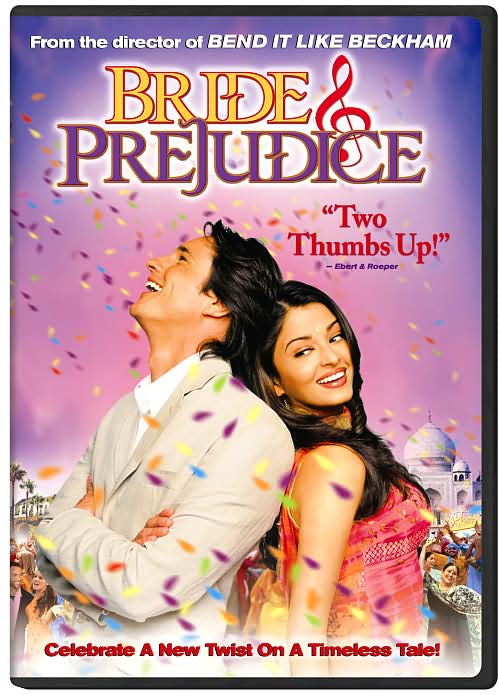
Some other P&P adaptations that I'd like to see (preferrably curled up on the couch on a rainy Sunday afternoon, my Bug napping, my Sweetie by my side, sipping Twinings Tea and munching on popcorn) are Bride and Prejudice (the Bollywood version!) and Pride and Prejudice: A Latter Day Comedy (the Mormon version!).

Okay, Maybe I Was Trying For This One ...
Okay, it would have been intolerable to have come out as any heroine other than dear Lizzy.
I'm certain that I was anticipating the answers most likely to point to "fine eyes" and a "lively mind."
So what?
I am like Elizabeth Bennet.

You are Elizabeth Bennet from Pride and
Prejudice! Yay, you! Perhaps the
brightest and best character in all of English
literature, you are intelligent, lively,
lovely-- in short, you are the best of company.
Your only foibles are that you stick with your
first impressions... and your family is quite
intolerable.
Which Jane Austen Character Are You?
brought to you by
Quizilla
Friday, November 11, 2005
Janey-Smarts!
| You Win!!! :> You scored 100% Janey-smarts |
| WELL DONE!!! Is she your favorite author too?? Even if she's not, you definitely know your stuff! Have your read the novellas? Of those, I recommend Lady Susan. :> |
|

Think you know Jane's novels? Take this test and find out your Janey-Smarts.
Friday, September 23, 2005
I Buy More Jane Austen Books
I have actually worn out paperback copies of my Jane Austen books. Mansfield Park is on its last legs. It would not survive another read-through. Pride and Prejudice has already had one copy recycled, and copy the second isn't looking too healthy anymore. Emma (not the NCE one), Northanger Abbey, Persuasion -- all could use retirement. The only one I haven't worn out is Sense and Sensibility, but, as I've already posted, that's the one I re-read the least.
I have also worn out many L.M. Montgomery books and have had to replace them. I just love books to their death - taking them everywhere: eating while reading, reading in the bath, marking my place by leaving them open -- belly-side down, spine up. Do not ever lend me a book, if you expect to get it back pristine. Jason, on the other hand, treats books with reverence and respect (but, I suspect, far less actual love) and handles them with kid gloves. He doesn't let me touch his books. I cannot really blame him.
So, new Jane Austen books for me -- a happy birthday indeed.
Wednesday, September 14, 2005
When I Fell for Fitzwilliam Darcy
Or, maybe I fell earlier still when Mr. Darcy said that a truly accomplished woman in his eyes must add to all feminine talents, civilities, and gentilities "something more substantial, in the improvement of her mind by extensive reading." Mr. Darcy: the ultimate embodiment of the thinking woman's hero!
What if Jane Austen had married her own Mr. Darcy? Happy for her to be the wife of such a man! Sad for us, since she would most likely have abandoned literary pursuits in her state of domestic felicity.
Wednesday, September 07, 2005
The Annotated Pride & Prejudice (2004)
I just got from www.bn.com The Annotated Pride & Prejudice, and it has exceeded my (admittedly high) expectations. The annotator/editor is David M. Shapard who, despite having graduated from UC Berkeley, takes a level-headed, even-handed approach to this most beloved of Jane Austen novels. While I have disagreed with a few of his "clarifications" of Austen's intended meaning, I have been very impressed by his scholarly approach to contextualizing this book in terms of time and place. Especially appreciated by this reader were the chronology appendix, the citations and cross-references from Austen's other works as well as her juvenilia and personal letters, and the handiness of having historical explanations and definitions immediately accessible to the text. I also really liked the fact that the annotations were all included on the right-hand side of the book, with the text on the left-hand side. Although it was a little difficult to get used to, it certainly beats having all the annotations at the end of the book, as was done by Dierdre La Faye in The Letters of Jane Austen collection. Most preferrable for me would have been the notes at the bottom of the pages of text, as is my MacArthur Study Bible, but I am determined to be pleased with what I can get. The only addition I can think of that would have improved this edition would have been some geneology charts for the characters, including their full names and relationships as far as Jane Austen provided. That would have been desirable indeed.
An endearing part of this edition lies in the acknowledgments that the editor provides prefacing the text. He thanks the "citizens of the Republic of Pemberley, who formed one of the inspirations for my decision to embark on the project in the first place, and whose questions and discussions concerning Jane Austen and Pride and Prejudice have stimulated my thinking and helped direct me to issues and points in the novel that deserve explanation or commentary." This tickled me pink, since I am such a fan of that wonderful community.
I cannot think of one library that would not be benefitted by this excellent edition. It is at least a venial sin for any Austentatious-type of collection to be without this well-done volume.
Friday, July 29, 2005
If I Were A Rich Mom - La-da-da-da-da-da-da-da-da-da-da!
(I wonder: Why the 89¢? Why not round it up to $43,475.00? Would anyone at all prone to purchasing such a tome be put off by that extra 11¢? But I digress.)
Aaah . . . for a spare $50,000!
There's your "pewter," dearest Jane, but none of it matters to you now. God bless you!
Sponging Off Jane
Thursday, July 14, 2005
Upon Re-Reading Mansfield Park . . .
**spoiler alert**spoiler alert**spoiler alert***
I know that in a few more pages, Henry Crawford will run off with Maria Rushworth, condemning him and her forever in the eyes of the Bertrams and Fanny Price. Oh, Henry, don't do it! You're getting so close to Fanny. Only let Edmund propose to Mary, let her accept his hand, and give Fanny a little while to get over her disappointment. Stay the course - she will reward your steadfastness with her love in just a little while. Don't show her that her opinion of your principles was well-founded. Don't do it!
I love MP, but the ending kind of stinks. Mary and Henry Crawford are so delightful. I cannot help but think that they would have, in turn, made better spouses for Edmund and Fanny than those two were for each other. Oh, Jane, what would you think of my impudence and audacity in wishing a re-write of the ending?
Fanny and Edmund - each one so principled and steady and virtuous and dull, dull, dull. I picture their married home-life as consisting of much sitting around, reading poetry, and rhapsodizing on Nature and its glories. Not that there is anything wrong with Nature and its glories - I rather like them myself - but where is the witty interplay of lively (and acerbic) observations of the human scene that made this Georgian/Regency era such a fun one? Fanny and Edmund have to be the most boring couple of protagonists ever to tie the knot in a Jane Austen novel.
And yet, I love this novel. It is so fine and well-written and entertaining. I actually bristled when I read one person's opinion that it was one of the "lesser works" of Jane Austen. It is, in fact, one of the greater works of all British Literature - thank you very much.
Jane Austen recorded for posterity all of her family's and friends' observations of MP. They are delightful, in and of themselves, to read. It is amazing how frank some of the comments are:
Mrs. Augusta Bramstone - owned that she though S&S and P&P downright nonsense, but expected to like MP better; &, having finished the first volume, flattered herself that she had got through the worst.
Fanny Cage - did not much like it - not to be compared P&P - nothing interesting in the characters - language poor - characters natural and well-supported - improved as it went on.
Mrs. Bramstone - . . . Preferred it to either of the others - but imagined that might be her want of Taste - as she does not understand Wit.
Edward & George (Knight - JA's nephews) - Not liked it near so well as P&P - Edward admired Fanny - George disliked her - George interested in nobody but Mary Crawford - Edward pleased with Henry C. - Edmund objected to as cold and formal - Henry C.'s going off with Mrs. R. - at such a time, when so much in love with Fanny, thought unnatural by Edward.
To this last, I must heartily agree. HC seems so in love with Fanny - he seems so likely to have reformed and refined his rakish ways - it just is too weird and jarring when we learn of the adulterous elopement. I'm sure JA wanted to shock us completely, but it is a most dreadful shock, because (at least to me) Henry Crawford seems a much better match for Fanny - who needs someone to liven her spirits. Mary Crawford would have shaped Edmund right up from his superfluity of gravity, and he would have steadied her character. Oh, it's just too bad.
Oh well, what's done is done. MP will be 200 years in print in just a few years. I'm sure JA would have been highly gratified to see its enduring popularity and success.
Monday, June 27, 2005
A Quick Ranking. . .
1. Pride & Prejudice - Goodness, I just re-read this novel for at least the tenth time. No better novel, in my opinion - not only Jane's best, but the best novel ever. "Light, bright and sparkling," with the heroine lovingly (and correctly!) described by her creator - "as delightful a creature as ever to appear in print." If you do not love Elizabeth Bennet, you may not be my friend.
2. Mansfield Park - Apparently, from others' opinions I have read, this is the red-headed step-child of the Austen ouvre. I just cannot see why anyone would not love it. It is so marvelously structured and so thoroughly intuited as far as character development. It leaves me in wonder at its perfection of style and tone. Fanny Price may not be the most charismatic of Austen heroines, but the ensemble production more than makes up for any of her deficiencies.
3. Persuasion - What a lovely novel! Austen's humor is still sharp, but the total effect of the work is softer somehow, more autumnal (to use the cliched description for this story). Anne Elliot is so real, and our invitation to her inner-self is one that we should not take too lightly. The major fault of this work is the whole Mrs. Smith revelation of Anne's cousin, which doesn't really work for me. It's rather jarring. I wonder how JA would have refined and re-worked her writing if she had lived to see it through publication. I'm just so grateful that we have it at all.
4. Emma - Emma Woodhouse is not a bad egg, and this novel is quite entertaining in the main. I think it runs on a little long, and some of the sub-plots are strange (what's with Harriet's nearly getting attacked by the gypsies with Frank Churchill's rescuing her?). We could have used a little more of the Eltons, who divert me exceedingly. Emma does not seem to have much to recommend her to Mr. Knightly (she seems to be the least intelligent of Austen's ladies - excepting Catherine Moreland), and Mr. Knightly seems too old for her anyway. The ending always leaves me a little off-kilter and wanting more of something and different of everything.
5. Northanger Abbey - There is a lot of humor in this strange, little work. It is entertaining, but obviously written by a diamond in the rough and not the accomplished author of S&S and beyond.
6. Sense & Sensibility - I have read this through several times, and I just can't force myself to love it over its number six placement. Since it is Jane Austen, it is far better than just about anything else you can read, though. Much like my feelings for Carolyn Arends' songs (about which I always think that the least liked of her songs still beats out a song by anyone else), I'd rather read S&S than something else by another author.
The Whys and Wherefores
This will be my little outpost of Austen Adoration, solely for my own amusement and anyone else's who happens to stumble across this humble blog.
So, to this first short post I will add:
"You deserve a longer letter than this; but it is my unhappy fate seldom to treat people so well as they deserve. . . .God bless you!" --Jane Austen, letter to Cassandra Austen (1798)